
How it works
Plumbing a Water Tank into Your Existing System
By the WaterQuotes team · Published 2026-08-17 · 6 min read
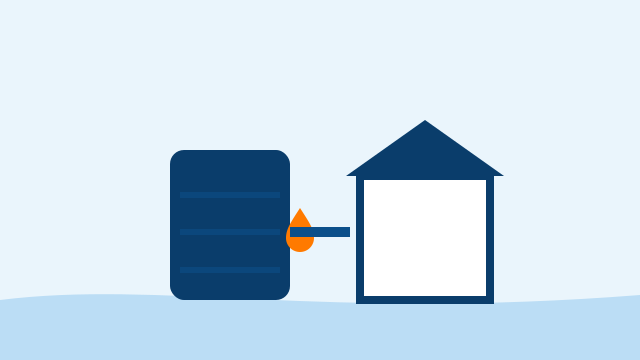
Most Johannesburg homeowners think of a backup tank as simply a big container sitting next to the house. The container is the easy part. What actually matters — and what most online articles skip over — is how the tank ties into your existing pipework, and why getting that connection point wrong leads to low pressure, contamination risk, or a system that only supplies half the house.
This article walks through the plumbing logic plainly, so you can have an informed conversation with any installer before work starts.
Why Your Existing Plumbing Needs to Change at All
Your current supply comes from Johannesburg Water’s mains at a pressure maintained by the municipality. That pressure pushes water through your pipes without any help from you. When you add a storage tank, you are introducing a second source — one that sits at atmospheric pressure if it is a gravity tank, or at pump pressure if it uses a booster. Your household pipes cannot simply have two pressurised sources fighting each other, and municipal water cannot be allowed to back-feed into a private tank. So the pipework must be deliberately reorganised at a specific junction.
This junction is commonly called the switchover point or break point, and it is where a plumber earns their money on this kind of job.
The Core Components a Plumber Installs
Regardless of tank size or location, a correctly plumbed backup system involves several components working together:
Isolation valves on the municipal supply line — these allow the household to be switched from mains to tank supply (manually or automatically) and ensure the two sources cannot pressurise each other simultaneously.
A non-return valve (check valve) — fitted on the municipal inlet side to prevent any stored tank water from pushing back into the municipal main. This is not optional; it is a basic requirement under good practice and aligns with the protections built into South African plumbing standards.
A break-pressure tank or float-valve inlet — if the tank fills directly from the mains, the inlet valve closes automatically when the tank is full, physically breaking the connection between mains pressure and stored water.
A booster pump — because a tank sitting on the ground (or even on a stand) cannot replicate municipal mains pressure by gravity alone, a pump is needed to push water through your existing pipes at workable pressure. Borehole pumps typically cost R15,000–R35,000 installed; a simpler tank-and-pump booster setup typically costs R20,000–R40,000, with whole-house configurations running around R55,000, though you should confirm actual figures through quotes for your specific property.
Pipework from the tank outlet to the switchover point — this new pipe run connects the pump outlet to your existing household supply line at the chosen junction.
For a broader overview of how these components fit into a complete backup strategy, the backup water systems guide covers the full picture, including how tanks, boreholes, and rainwater harvesting compare.
Where the Switchover Point Should Sit
This is the decision that most affects how useful your tank actually is.
If the switchover point is placed at your main stopcock — the point where the municipal supply enters the property — then the tank feeds the entire house: all taps, the geyser, washing machine, toilets, everything. This is the most complete solution but requires the booster pump to handle the full household demand.
If the switchover point is placed further downstream — say, only to a kitchen tap or a single bathroom — costs and pump sizing come down, but you lose supply to the rest of the house during an outage.
Most Johannesburg households opt for a whole-house connection point, particularly given that Johannesburg Water’s own figures show non-revenue water (a proxy for system stress and leakage) running at 44.8% in 2024/25, and the city’s reservoir system holds roughly 27 hours of citywide storage buffer. Those numbers suggest supply interruptions are a real ongoing risk, not a theoretical one — which makes partial coverage a compromise worth thinking carefully about.
Working out the right connection point for your property is exactly where quotes from competing installers add value. Compare 3 free quotes — vetted installers, no obligation.
Pressure: the Detail Most Homeowners Miss
Municipal mains pressure in Johannesburg residential areas varies, but your existing taps, showerheads, and appliances are calibrated around a reasonably consistent incoming pressure. A backup pump needs to match or approximate that pressure to avoid weak showers, appliances that won’t trigger flow sensors, or — in the opposite direction — excessive pressure that stresses older pipes.
A competent plumber will measure your existing mains pressure before specifying a pump, and should set the pump’s pressure switch (or variable-speed drive) to deliver a comparable figure. If this step is skipped, pressure complaints after installation are predictable.
Geyser and hot-water system interactions are another consideration. Many Johannesburg homes have older geyser setups with their own pressure-limiting valves. When the supply switches to a pump-fed tank, those valves may behave differently. Your plumber should check geyser inlet pressure as part of the installation, not leave it as a post-installation discovery.
Practical Plumbing Steps on Installation Day
If you want to understand what the team is actually doing, here is the typical sequence:
| Step | What happens | Why it matters |
|---|---|---|
| Isolate mains supply | Main stopcock closed | Safe working conditions |
| Cut into supply line at switchover point | New tee or junction fitted | Creates the connection for tank feed |
| Install isolation valves either side | One on mains side, one on tank side | Allows switching and future maintenance |
| Fit non-return valve on mains inlet | Prevents back-flow to municipal main | Health and regulatory requirement |
| Run pipe from tank outlet to junction | New pipe route through or around the house | Connects stored water to the household system |
| Install and wire booster pump | Pump fitted between tank outlet and junction | Restores usable pressure from the tank |
| Test switchover and pressure | Switch to tank, check all outlets | Confirms system works as intended |
The specifics vary by property layout — a double-storey in Sandton is a different job to a single-level home in Roodepoort — which is why the pipework plan should be drawn up on site, not quoted remotely.
For more on what the physical installation involves, the article on installing a backup water tank covers positioning and civil work, and connecting a backup tank for whole-house supply goes deeper on the whole-house feed configuration specifically.
If you're ready to get actual numbers for your property, getting competing installer quotes side by side is the most reliable way to check you're paying a fair price. Get 3 free installer quotes — no commitment required.
What to Check Before Signing Off the Job
Once installation is complete, do not simply take the plumber’s word that everything is correct. Ask them to demonstrate the following before they leave:
- Switch to tank supply with the mains isolated, and run multiple outlets simultaneously. Pressure should feel comparable to normal mains supply.
- Show you where each isolation valve is and explain how to switch manually if the automatic system fails.
- Confirm the non-return valve location and explain how to access it for future inspection.
- Provide documentation of the system layout — even a hand-drawn sketch — so a different plumber can work on it later without guessing.
Water quality is a separate consideration. Stored water in a tank can deteriorate if the tank is not properly sealed, UV-stabilised, and periodically cleaned. South Africa’s drinking-water quality standard is SANS 241 (2024 edition); if your stored water will be used for drinking or cooking, confirm with your installer how the system addresses that standard, including any filtration or treatment at the outlet.
The plumbing connection itself, done correctly, is straightforward work. The value is in getting the switchover point right, specifying a pump that matches your actual pressure needs, and ensuring isolation and non-return valves are fitted properly from the start.
Quick answers
Does a plumber need to touch the municipal supply line to install a backup tank?
Yes, in almost every whole-house installation. A tee or junction must be cut into your existing supply line at the switchover point, and isolation valves and a non-return valve must be fitted there. This work requires isolating the mains supply beforehand and should be done by a qualified plumber.
Will water pressure drop when running from the backup tank?
It depends on the pump specified. A correctly sized booster pump should deliver pressure comparable to your normal mains supply. If the pump is undersized or not properly set, pressure will be noticeably lower. Ask your installer to measure your existing mains pressure and confirm the pump specification matches it.
Can the backup tank water be used for drinking?
Only if the system is designed for it. The tank must be food-grade, sealed against contamination, and ideally include filtration or treatment at the outlet. South Africa's drinking-water quality standard is SANS 241 (2024 edition), and stored water should meet this if it is to be used for drinking or cooking. Confirm with your installer what treatment is included.
How much does it typically cost to plumb a backup tank into an existing system?
Backup tank-and-pump systems typically cost R20,000–R40,000, with whole-house configurations running around R55,000 as a rough guide — but these figures vary significantly based on property size, existing pipework layout, and pump specification. Get at least three quotes from installers who have visited your property before committing to any number.
Does the non-return valve really matter, or is it optional?
It is not optional. A non-return valve on the municipal inlet side prevents stored tank water from pushing back into the municipal main, which is both a health risk and a potential breach of plumbing standards. Any installer who suggests skipping it should be questioned closely.
Sources & notes
Pricing reflects typical Johannesburg market ranges and is confirmed by installer quotation. References: SABS
Ready to compare? Get up to 3 quotes from vetted backup water systems installers in Johannesburg — free, no obligation.
Get 3 free quotes